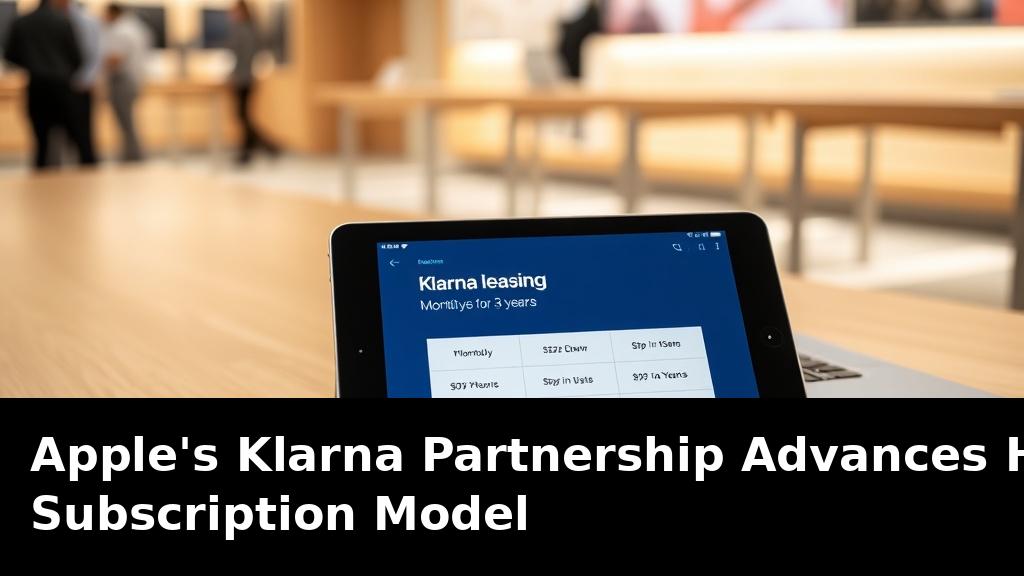
Apple is preparing to launch a new leasing arrangement with Klarna that will allow customers in the United States to spread the cost of premium devices across a period of up to three years. The program arrives ahead of the iPhone’s twentieth anniversary and forms part of Apple’s broader movement toward recurring revenue streams that combine hardware, software, and services.
Under the arrangement, participants can access selected Apple products through monthly payments while retaining the ability to upgrade at regular intervals. AppleCare coverage remains separate and requires an additional payment. Several lower-priced items, including the MacBook Neo, Apple Watch SE, entry-level iPad, and iPhone 16, fall outside the scheme, indicating that Apple views these models as already accessible without financing support.
The timing of the initiative coincides with upward pressure on component costs driven by increased demand for advanced memory. By offering a structured payment path, Apple aims to maintain upgrade momentum among customers who might otherwise delay purchases amid economic uncertainty. Analysts note that this approach protects the replacement cycle without requiring Apple to absorb credit risk on its own balance sheet.
Beyond immediate sales considerations, the program accelerates Apple’s transition to a hardware-as-a-service framework. When combined with existing subscriptions such as Apple One, the Klarna option creates a more comprehensive monthly bundle that covers both physical devices and digital services. This evolution mirrors patterns already visible in other industries where ownership is gradually replaced by access agreements.
A further consequence lies in Apple’s strengthened position over the secondary market. Because devices are leased rather than sold outright, the company gains greater control over end-of-life units, facilitating refurbishment, resale, and responsible recycling. Over time this control could expand Apple’s influence in the pre-owned segment, an area that continues to grow in value.
Consumer attitudes have also shifted. After years of promoting subscription services, Apple has normalized the idea of paying monthly for valued technology. With more than one billion paid subscriptions already in place and an installed base exceeding 2.5 billion active devices, the infrastructure exists to support wider adoption of device leasing.
From a risk-management perspective, partnering with an established third party allows Apple to capture demand upside while avoiding the regulatory and financial exposure that would accompany an in-house buy-now-pay-later product. The decision reflects a calculated balance between growth objectives and prudent financial oversight.
Taken together, these elements suggest that Apple’s latest arrangement is less about any single product launch and more about embedding recurring payments into the core customer relationship. As prices for high-specification models continue to rise, the ability to access the latest hardware through predictable installments may become an increasingly central part of the Apple ecosystem.