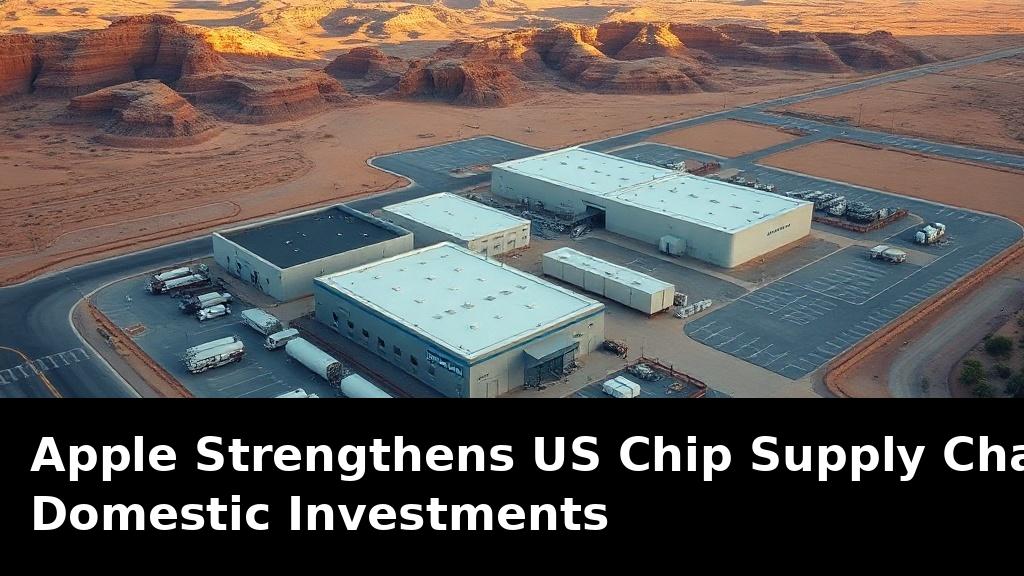
Apple has entered into a $30 billion multi-year agreement with Broadcom to manufacture billions of chips for its devices within the United States. This arrangement supports hundreds of domestic jobs and represents the company’s largest US procurement commitment to date. The chips in question include custom silicon components and wireless connectivity technologies such as RF and wireless chips for Wi-Fi, Bluetooth, and cellular applications, rather than the primary application processors.
Apple has indicated that additional processors for its devices will eventually carry domestic manufacturing designations. This development forms part of a wider initiative to establish an end-to-end silicon supply chain in America. The total value of related investments announced so far reaches approximately $295 billion, encompassing processor fabrication, advanced packaging, and connectivity components.
TSMC has separately confirmed an additional $100 billion investment in four new US facilities, including one dedicated to 2nm and smaller process nodes. These plants will incorporate packaging capabilities that integrate memory, processor, and networking elements into final system-on-chip designs. Such capacity is expected to serve Apple’s current and future device requirements alongside those of other clients.
Beyond these two major partners, Apple’s American Manufacturing Program has engaged several additional suppliers. GlobalFoundries will produce mixed-signal chips for Face ID systems, while Texas Instruments expands analog and power chip output. Samsung is introducing a novel chip-making process at its Austin facility, and Amkor has established an advanced packaging and test site in Arizona where Apple serves as the primary customer. Corning and Applied Materials have also committed resources under the same program.
These moves occur against a backdrop of efforts to enhance supply chain resilience following recent global disruptions. By concentrating high-value fabrication and packaging activities domestically, Apple can maintain greater control over critical components while retaining flexibility for final assembly operations elsewhere.
The strategy also positions the United States to retain advanced technical expertise and high-paying roles in semiconductor engineering. This selective localization of sophisticated processes supports broader national objectives around technological leadership without requiring complete repatriation of all assembly lines.
Questions remain regarding the comparative production costs of US-manufactured chips relative to those produced in other regions. Nevertheless, the cumulative scale of commitments demonstrates a deliberate emphasis on securing strategic elements of Apple’s hardware ecosystem within the domestic market.